

The Rise and Fall of Alcohol in American Culture
For nearly as long as America has existed, alcohol has been woven into the fabric of daily life.
It ‘s been a celebration, a business, a political issue, a social ritual, a source of comfort… and at times, a source of enormous pain. Few things have held such a prestigious but complicated place in American culture for so long.
As America celebrates its 250th birthday, let’s look back at the country's long and ever-changing relationship with alcohol.
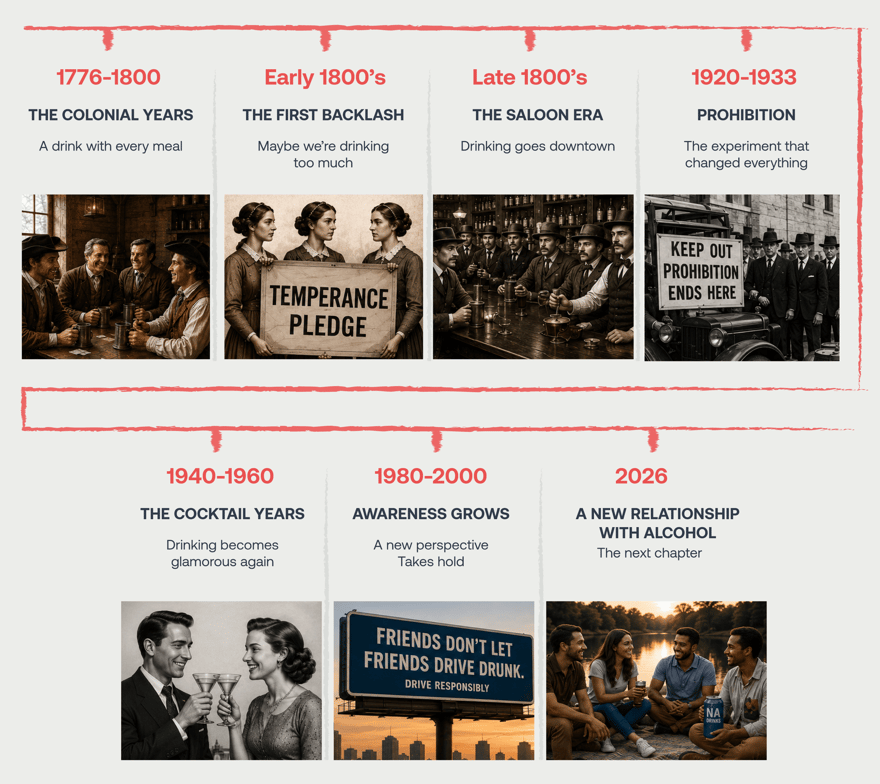
The Colonial Years: A Drink With Every Meal
If you walked through colonial America, you would have seen alcohol pretty much everywhere.
People drank cider, beer, rum, and whiskey like it was water. Taverns were a hub of social life – they served as communal gathering places where neighbors exchanged news, did business, and debated politics. Even children often drank weak forms of beer or cider because water supplies were not always trusted or known to be safe.
Alcohol wasn't viewed as reckless or dangerous. It was just part of life.
George Washington himself operated one of the largest whiskey distilleries in the country. Interestingly, farmers often turned grain into whiskey, because it was easier to transport and sell than raw crops. Drinking was so common that many Americans simply couldn't imagine a society without it.
At the time, alcohol wasn't controversial; it was as ordinary as bread on the table.
The First Backlash: "Maybe We're Drinking Too Much"
But by the early 1800s, attitudes began to change.
As drinking became heavier and more widespread, more Americans started noticing the consequences of alcohol. Families struggled. Workers missed shifts. Public drunkenness and embarrassing incidents became too common in some communities. And a growing number of people began asking whether alcohol was doing more harm than good.
This gave rise to the Temperance Movement, one of the first large-scale social reform efforts in American history. Churches, community leaders, and everyday citizens encouraged moderation - or complete abstinence from alcohol. For the first time, Americans were having a national conversation about alcohol's impact on society.
What had once been viewed as an ordinary part of life was increasingly being viewed as a problem that needed solving.
The Saloon Era: Drinking Goes Downtown
Then, as America hit the Industrial Revolution of the late 1800s, alcohol took on a whole new role.
Cities grew rapidly. Impoverished, hopeful immigrants arrived from around the world. Factories ran long, exhausting hours. And saloons appeared on nearly every busy street corner.
These weren't just places to drink; they were social clubs, gathering spaces, and community hubs. For many working-class Americans, the local saloon was where friendships were built, deals were made, and daily stresses were forgotten.
At the same time, critics saw something different. They saw breadwinners spending their family’s grocery money on drinks. They saw drunken violence, terrible poverty, and public disorder. They saw alcohol as a growing threat to American values.
The debate became increasingly heated. By the turn of the century, Americans seemed almost divided into two camps: those who believed alcohol was a normal part of life and those who believed it was destroying it.
Prohibition: The Experiment That Changed Everything
Then, in 1920, the United States launched one of the boldest social experiments in history: The manufacture, transportation, and sale of alcohol became illegal nationwide.
Supporters hoped Prohibition would create a healthier, safer, more productive society. And in some ways, alcohol consumption initially declined. But there was one problem: Americans didn't stop wanting alcohol.
Instead, drinking simply went underground. Secret bars known as “speakeasies” appeared across the country. Bootleggers built massive criminal empires. Homemade alcohol recipes became the norm. And organized crime flourished in a dramatic and terrible way.
In short, what was once sold openly now operated in the shadows.
By the early 1930s, many Americans had grown frustrated with the strong unintended consequences of Prohibition. And in 1933, the 13-year experiment ended when the 21st Amendment repealed the national ban. To date, it remains the only constitutional amendment ever repealed.
The Cocktail Years: Drinking Becomes Glamorous Again
After Prohibition ended, alcohol gradually returned to mainstream American life.
By the 1940s and 50’s, drinking had acquired a whole new image. Advertisements portrayed cocktails as “sophisticated”. Movies featured elegant dinner parties with drinks in hand. Businessmen toasted deals over martinis. Alcohol became associated with success, confidence, and adulthood. For many Americans, having a drink wasn't just acceptable—it was fashionable.
The message was subtle but loud: Drinking wasn't something questionable people did. It was something successful people did.
This image would go on to shape American culture for decades.
A Changing Perspective
But by the late 20th century, public attitudes started shifting again.
Research increasingly highlighted the health risks associated with excessive drinking. Advocacy groups brought attention to the dangers of drunk driving. Communities began talking more openly about alcoholism and recovery. Slowly, Americans started viewing alcohol through a more complicated lens.
It was no longer just a symbol of celebration or sophistication.
People were beginning to recognize that alcohol could affect families, health, careers, and communities in profound ways. The conversation was becoming less about morality - and more about the risk, responsibility, and treatment.
Today: A New Relationship With Alcohol
In 2026, America finds itself in a very different place than it was 250 years ago.
Alcohol is still deeply embedded in celebrations, sporting events, restaurants, holidays, and social gatherings. For many people, it’s still a normal part of life – and always will be.
But something else is happening, too.
More and more people are questioning alcohol's role in their lives. Movements like Dry January and “sober-curious” have entered public consciousness. And younger generations are often more willing to talk about mental health, wellness, and recovery than the ones before them. For perhaps the first time, choosing not to drink is becoming just as socially acceptable as choosing to drink.
The conversation is changing.
America's story with alcohol has never been simple. Over 250 years, we’ve embraced it, challenged it, banned it, celebrated it, glamorized it, and questioned it.
And that story is still being written.
If the last 250 years were about alcohol's place in American culture, maybe the next chapter will be about something new: Achieving balance, and realizing that recovery belongs in the American story too.