

When substances become a way to cope
One of the biggest misconceptions about addiction is that people think it exists separately from mental health.
In reality, you can hardly treat one without the other.
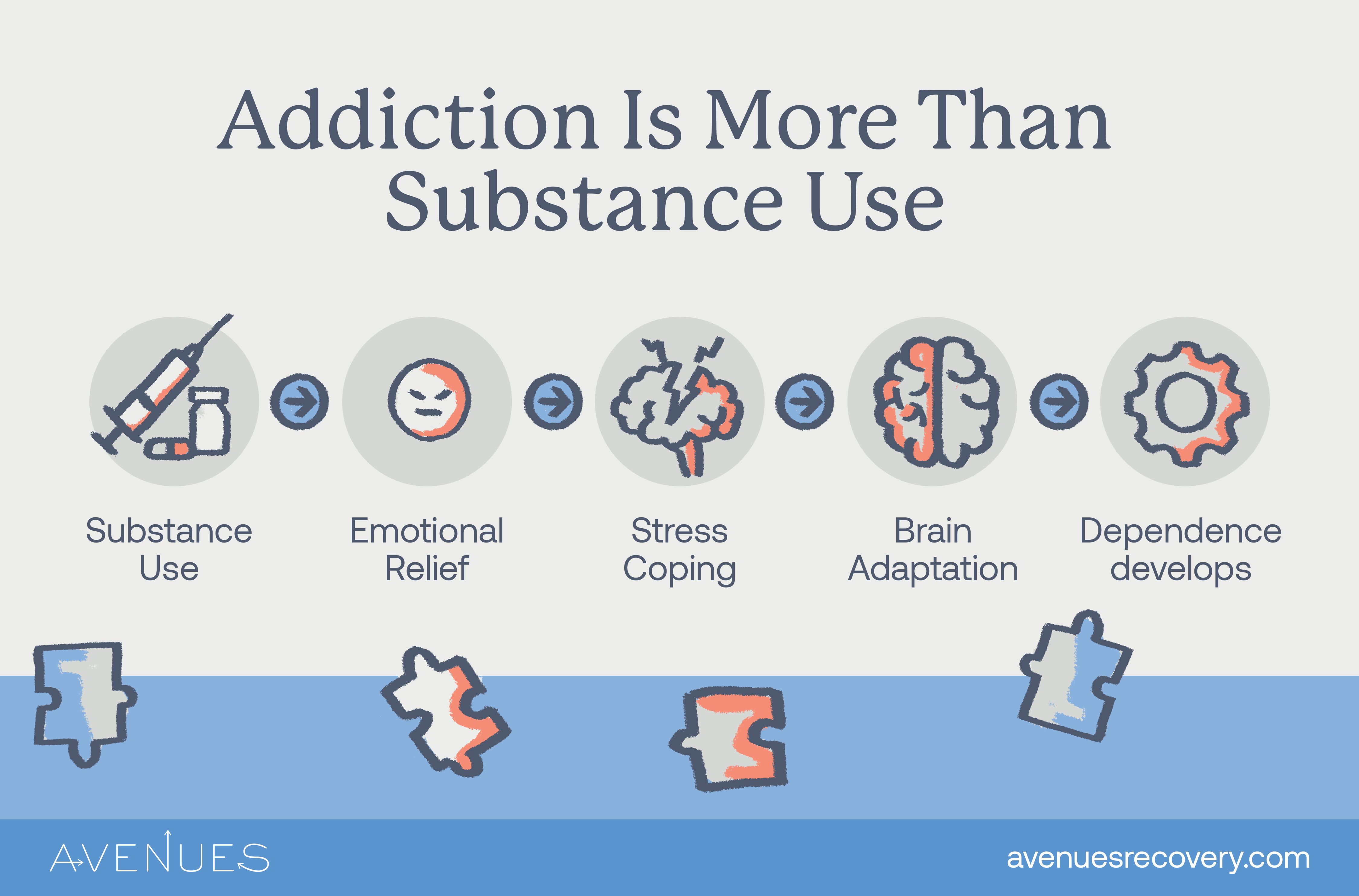
A lot of people struggling with substance use are also dealing with anxiety, depression, trauma, emotional overwhelm, or chronic stress underneath it all. Over time, the brain begins linking the substance to relief.
That’s an important word: relief.
For many people, substances are not simply about wanting to feel “high” or escape reality. The brain starts associating them with feeling calmer, more stable, less anxious, less emotionally overwhelmed, or sometimes even just functional enough to get through the day.
Why willpower alone isn’t enough
Over time, addiction changes the brain.
The systems involved in mood, stress, motivation, and emotional regulation begin to transform.
- Natural dopamine function becomes disrupted
- Stress sensitivity increases
- Emotional regulation gets harder
- Emotional health
- Physical health
- Stress levels
- Relationships
- Daily habits
- The nervous system
- Sleep
- Nutrition
- Movement
- Exercise
- Mindfulness
- Emotional support, and
- Human connection
That’s why someone can genuinely want to stop and still feel unable to.
Families often ask:
“If they know it’s hurting them, why can’t they just stop?”
Because at a certain point, the brain is no longer experiencing the substance as a simple choice. It has become tied to survival, coping, and emotional regulation.
That doesn’t mean recovery is impossible. But it does mean we need to understand what people are actually fighting.
Why early recovery can feel so difficult
When someone stops using, they are not just removing a substance. They are also losing a coping mechanism their brain has depended on for stability. That’s why early recovery can feel emotionally intense.
People may feel anxious, restless, emotionally exposed, overwhelmed, depressed, or unable to experience pleasure normally for a period of time. This is not failure. It’s part of the healing process.
One thing I see often is that relapse usually doesn’t happen randomly. There’s usually a trigger. An event. A stressor. An emotional shift. Something internally or externally overwhelms the system.
That’s why treatment has to go deeper than simply removing the substance.
Recovery requires whole-person healing
The most important thing early on is helping the brain stabilize enough for a person to fully participate in recovery: to sit in a group, listen, process emotions, and begin learning new ways to cope.
Sometimes medication plays an important role in creating that stability. Therapy matters too. Structure matters.
But recovery is never just about one thing.
We have to treat the whole person.
That means looking at all the pieces:
And then there’s the holistic side that matters just as much:
all play a role in helping the brain and body heal together.
These are not “extra” parts of treatment. They are part of helping someone feel safe, regulated, and capable of functioning again without relying on substances to get through the day.
The brain can heal
Recovery takes time because the brain needs time to build new coping pathways and relearn how to manage stress, emotions, and everyday life without substances.
But the brain can heal.
I’ve seen people rebuild their lives in incredible ways.
People with years and years of sobriety under their belts.
People who once felt completely stuck go on to rebuild relationships, stability, purpose, and joy.
It’s hard. This is a hard disease.
But it’s not impossible.