

How cocaine is made involves several steps, including soaking, separating, and then purifying coca leaves to produce the final substance. Avenues Recovery, leading specialists in drug detox treatment and addiction rehabilitation, shares the modern cocaine recipe, from the lengthy refinement process to common additives, to illustrate the real dangers and pitfalls of cocaine use.
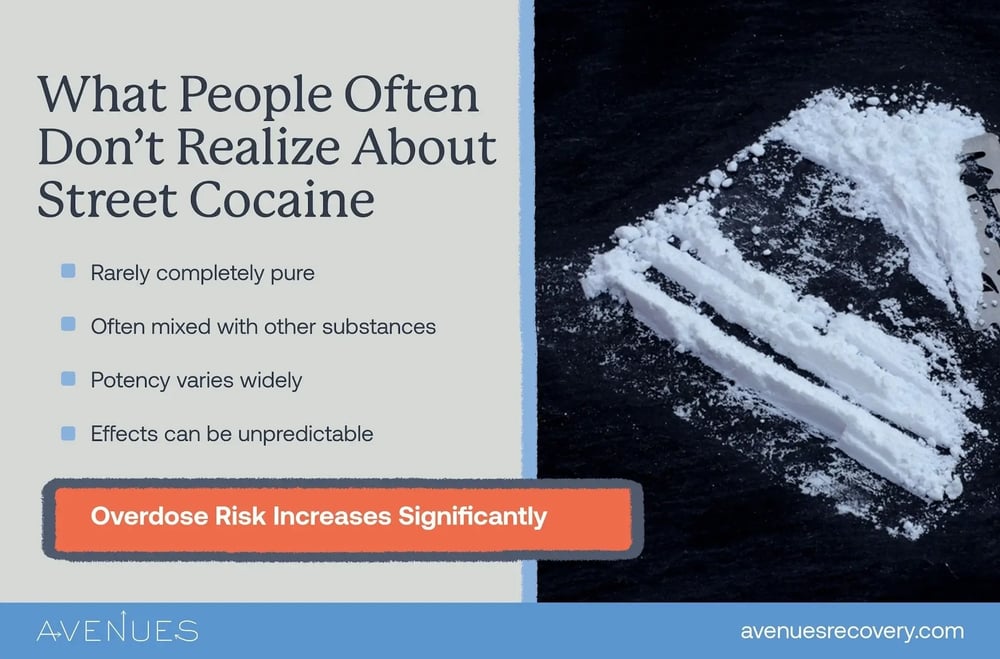
Because the cocaine production process is so lengthy and complicated, the final product is expensive and often "cut" with other dangerous substances. You think it's pure cocaine, but it's far from that. Using street cocaine can end in a fatal overdose.
Payal Kakaria, BSN, RN, is the Director of Medical Development at Avenues Recovery Center. A registered nurse by training, she brings a strong foundation in patient-centered, evidence-based care and is committed to advancing high-quality clinical practices across treatment settings.
Key Takeaways on How Cocaine Is Made
- Cocaine is extracted from coca leaves by soaking them in gasoline and other solvents like lime, acid, and potassium.
- It takes about 450–600 kg of fresh coca leaves to produce just 1 kg of cocaine, which is a big reason the drug is so expensive.
- Crack cocaine is made by boiling powdered cocaine with water and baking soda into a smokable rock form.
- Street cocaine is rarely pure, and it's often cut with anything from harmless fillers to dangerous substances like fentanyl, or even deadly poisons.
- Because of the unpredictable additives in cocaine, using it from an untrusted source carries serious, sometimes fatal, risk.
How Is Cocaine Made?
The process of making cocaine hydrochloride powder from the raw coca plant is a long and labor-intensive one, which contributes to its prohibitive cost. Below are the basic steps of how to make cocaine:
- Step 1: Coca leaves are harvested from the coca plant.
- Step 2: The coca leaves are soaked in gasoline to isolate and extract their alkaloids (specifically cocaine hydrochloride).
- Step 3: The leaves are drained of gasoline and then dried.
- Step 4: The treated leaves are mixed with other solvents such as lime, cement, acid, and potassium to extract the remaining active alkaloids. The resulting product is coca paste.
- Step 5: The mixture is soaked in acetone and acid, and drained a final time, to create cocaine base.
- Step 6: Any remaining leaves are strained away, and the resulting paste is heated, dried, and pressed into bricks.
What is Crack Made Of?
Crack cocaine is made by mixing powdered cocaine with water and baking soda or a similar substance, and boiling it until it forms a rock-like substance that can be broken into smaller pieces.
In the process, the hydrochloride is removed from the pure form of cocaine, making the product smokable. Crack cocaine is often cheaper than powder cocaine, and it produces a very short, intense high.
Where Does Cocaine Come From?
Cocaine is made from two species of the coca plant native to South America, specifically from countries like Colombia, Peru, and Bolivia. These regions have the ideal climate and altitude for cultivating the coca plants, which are the active ingredients in the cocaine recipe.
How Does Cocaine Work?
Cocaine works by increasing levels of dopamine, a neurotransmitter in the brain associated with pleasure and reward. As a central nervous system stimulant, cocaine speeds up many bodily functions and induces euphoria, energy, mental alertness, and hypersensitivity.
The effects of cocaine are felt almost immediately and are short-lived, disappearing within a few minutes to an hour. In its powdered form, cocaine may be snorted and inhaled, dissolved and injected, rubbed on the gums, or heated and smoked. Cocaine is classified as a Schedule II drug, indicating that it has a high abuse potential as well as a legitimate medical use in some specific situations.
Origins of Cocaine: Who Invented Cocaine?
For over a thousand years, the Indigenous peoples of South America have chewed the leaves of the Erythroxylum Coca plant from which cocaine is made, for its many nutrients and pleasure-inducing alkaloids. When Spanish conquistadors arrived in the Americas, they first banned the coca plant as an “agent of the devil”, but then reversed the decision when they saw that the natives were simply unable to work without it.
Discovering How to Make Cocaine
In 1855, German chemist Friedrich Gaedcke successfully isolated the alkaloid cocaine from the coca plant and named it “erythroxyline”. Over the next century, numerous studies, experiments, and trials were conducted with this new alkaloid, and countless products were created with it, such as:
- Coca wines
- Cocaine hair tonics
- Cocaine toothache drops
Additional Uses of Coca Leaves
Was there cocaine in Coca-Cola? John Pemberton’s original recipe for Coca-Cola included the key ingredient “a pinch of coca leaves” (which has long been removed since the passing of the Pure Food and Drug Act). It also gained popularity in medicinal circles as an effective analgesic and local anesthetic.
Cocaine was strongly considered by the German Army for use as a performance and endurance-enhancing drug (aka “pep pill”) in troops during WWII. In modern times, its medical use faltered in the face of new, increasingly effective analgesics, and it has rapidly devolved into a recreational party drug that is widely used and abused. Today, cocaine is a glamorous drug widely associated with the rich and famous.
Where Is Cocaine Made?
The seat of the cocaine-making process is indisputably the continent of South America. Cocaine is produced in various South American countries, including Colombia, Bolivia, Peru, Ecuador, Venezuela, Brazil, Argentina, and Chile. Colombia stands out as the world's leading cocaine exporter, making it a significant hotspot. According to a UNODC survey, the cultivation of coca bushes in Colombia rose by 10% in 2023, reaching 253,000 hectares. As a result, potential cocaine production increased to 2,664 metric tons.
Due to its warm climate, fertile soil, and higher altitude, Colombia produces especially potent cocaine leaves, which are favored by drug dealers and users.
What Plant Does Cocaine Come From?
Cocaine is extracted from the leaves of the coca plant. To be specific: It takes approximately 450 – 600 kilograms of fresh coca leaves to produce a mere 1 kilogram of cocaine base, which can then be converted into 1 kilogram of cocaine hydrochloride.
How to Grow Cocaine
Cocaine can only be grown in specific tropical climates, with high humidity, consistent rainfall, nutrient-rich soil, and altitudes between 1,500 and 6,000 feet. Because these regions support the coca-growing stage of the cocaine process, cultivation is primarily concentrated in South America, most commonly in Colombia, Peru, and Bolivia.
What Ingredients Are In Coke?
Coke, the slang term for cocaine, may contain several ingredients in addition to just the coca plant. This is due to the complicated and exhaustive process that makes it one of the most expensive drugs on the market. The final cost depends on factors such as purity and location.
In an attempt to lower costs and increase supply and profit margins, drug suppliers have taken to cutting cocaine with a wide variety of substances. These additional substances can range from relatively benign to deadly.
Safe Additives Commonly Added to Cocaine
Some additives in the list of cocaine ingredients are relatively harmless and are used only to mimic the white powder appearance of cocaine hydrochloride (and possibly weaken its effects).
The list is exhaustive and includes but is not limited to:
- Talc
- Flour
- Cornstarch
- Sugar
- Sodium bicarbonate (baking soda)
- Vitamin C powder
- Glucose
- Baby formula
- Quinine
- Thiamin (aka Vitamin B1)
- Tyramine (can induce migraines)
- Sodium carbonate (aka washing soda)
- Magnesium silicate (aka asbestos)
- Magnesium sulfate (Epsom salts)
- Salicylamide (an over-the-counter painkiller)
- Calcium
- Magnesium
- Sodium
- Phosphorus
- Aluminum
- Iron
- Manganese
- Zinc
Dangerous Additives Often Added to Cocaine
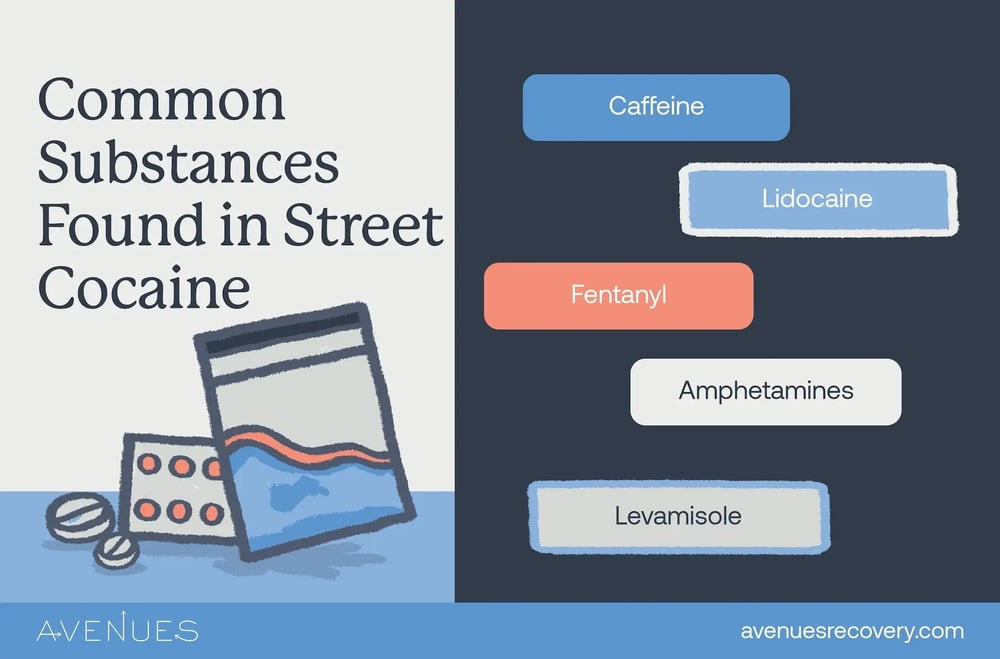
Cheap white stimulants are often used to recreate the psychoactive or numbing effects of cocaine, and some can have dangerous or even fatal consequences when ingested. These include:
- Caffeine
- Heroin
- Amphetamines
- Crystal Meth
- Methylphenidate
- Ergotamine
- Aminophylline
- Procaine (often called Novocain)
- Lidocaine
- Tetracaine
- Benzocaine
- Fentanyl
Above all cutting agents, fentanyl poses by far the greatest danger. Fentanyl is an incredibly powerful synthetic opioid that is 50 times more potent than heroin and 100 times more potent than morphine. Other, more toxic analogs of fentanyl, such as carfentanil, have been detected in cocaine as well. A lethal dose of carfentanil is so minuscule that it is invisible to the naked eye.
Deathly Additives Occasionally Added to Cocaine
Additionally, random poisons have been found cut into cocaine samples. This is an unusual but fatal occurrence called a “death hit” by cocaine users. Below are some poisons that have been found in cocaine:
- Strychnine (commonly used in rat poison)
- Arsenic (a natural and highly toxic chemical element often used as poison)
- Levamisole (an anthelmintic drug used to treat parasitic worm infections in livestock)
- Thallium (an odorless, tasteless heavy metal with highly toxic properties)
An evaluation of the average purity of cocaine revealed that nearly 80% of street cocaine contains levamisole, which can cause severe necrosis and mass death of cells in the skin tissue due to failure of blood supply.
Understanding How Cocaine Is Made and Exercising Caution
Understanding how cocaine is made explains why the final product carries such a high price tag. And because of the lengthy process and steep price, one thing it rarely turns out to be is pure cocaine. The end product is usually an undocumented amalgamation of many different substances, ranging from useless to lethal.
It cannot be stressed enough: Extreme caution must be exercised whenever using cocaine, or any drug, for that matter, to ensure that it is not tainted with agents that may have disastrous consequences.
Reach Out to Avenues Recovery
Learning how cocaine is made and internalizing the dangers of ingesting this drug is the first step towards a healthier future. If you or a loved one is suffering from cocaine addiction, know that help and healing are always possible. Join our 30K+ successful alumni, who have been given a new lease of life by the professional and caring team at our top-rated rehab centers. Reach out to Avenues Recovery to discover how we can help you begin your journey home.
FAQs About How Cocaine Is Made
How long does it take to make cocaine?
The process of making cocaine can take over a year, due to cultivation time. The coca plant needs 12-18 months to reach maturity after planting, but the actual chemical processing of cocaine can be completed in a matter of days.
Is cocaine a plant?
Not exactly. Cocaine itself is not a plant; it's a chemical compound extracted from the leaves of the coca plant. The coca plant is native to South America and contains the alkaloids that, once isolated and refined, become cocaine.
When was cocaine invented?
Cocaine was first isolated as a pure alkaloid in 1855 by Friedrich Gaedcke. A more refined extraction method was later developed in 1860 by another German chemist, Albert Niemann, which is often cited as the true "discovery" of cocaine as it's known today.
Is cocaine natural or synthetic?
Cocaine is a natural substance. It's derived directly from the leaves of the coca plant, native to South America. However, street cocaine is rarely pure, as it's frequently cut with other natural or synthetic substances during production and distribution.
Is cocaine made with gasoline?
Yes. Gasoline is commonly used in the early stages of cocaine production to help extract alkaloids from the coca leaves. Traces of gasoline can sometimes remain in the final product due to incomplete refinement.
What is in cocaine?
Pure cocaine is a chemical compound (cocaine hydrochloride) extracted from coca leaves. However, street cocaine is often mixed with a wide range of additives, from relatively harmless substances like cornstarch and baking soda to dangerous ones like fentanyl, and even deadly poisons like arsenic in rare cases.